
Ecology and safety
Safety and environment
Volume, management and cost of radioactive waste and spent nuclear fuel (SNF)
A standard 1000 MW light water reactor annually generates (directly and indirectly) about 200 – 350 m3 of low and intermediate radioactive waste. About 20 m3 (27 tons) of spent fuel are also generated annually, this volume decreasing to 3 m3 after processing (vitrification)
 350 m³
Volume of a single-family house
 300 m³
Volume of low and intermediate radioactive waste
 20 m³
20 m³
Volume of spent nuclear fuel (SNF)
 3 m³
3 m³
Volume of high-level radioactive waste after reprocessing of spent nuclear fuel
1 nuclear power plant = millions of households
A nuclear power plant with a capacity of about 1,000 MW can provide electricity for over 2 million households, with constant and predictable operation, regardless of weather conditions.
Above 90% usability factor
Nuclear power plants operate with one of the highest utilization rates in the energy industry – over 90% per year, which means almost continuous electricity production.
Almost zero CO₂ emissions in production
Nuclear power generation does not emit carbon dioxide during operation, making it among the lowest-emission energy sources.
Designed for decades to come
Volume of high-level radioactive waste after reprocessing of spent nuclear fuel
Safety through independent systems
Nuclear facilities rely on a multi-level safety system, including independent active and passive protective mechanisms designed to prevent and limit any deviations.
One of the most regulated industries in the world
Nuclear energy is subject to strict national and international control, including constant monitoring, inspections, and licensing regimes.
Spent nuclear fuel storage
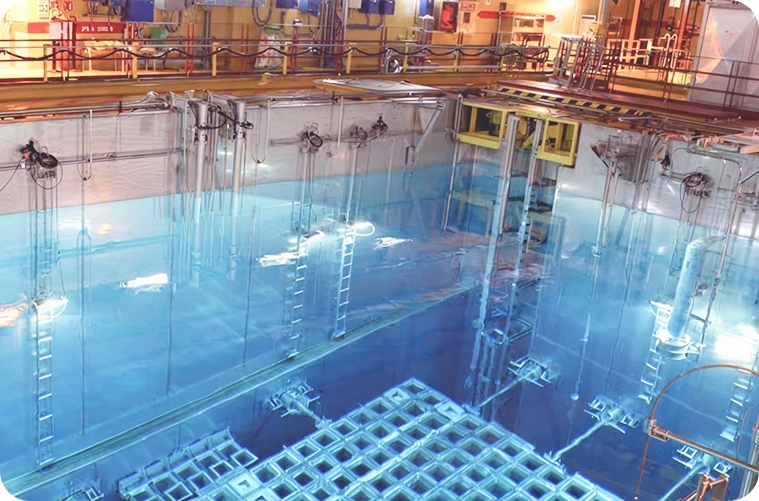
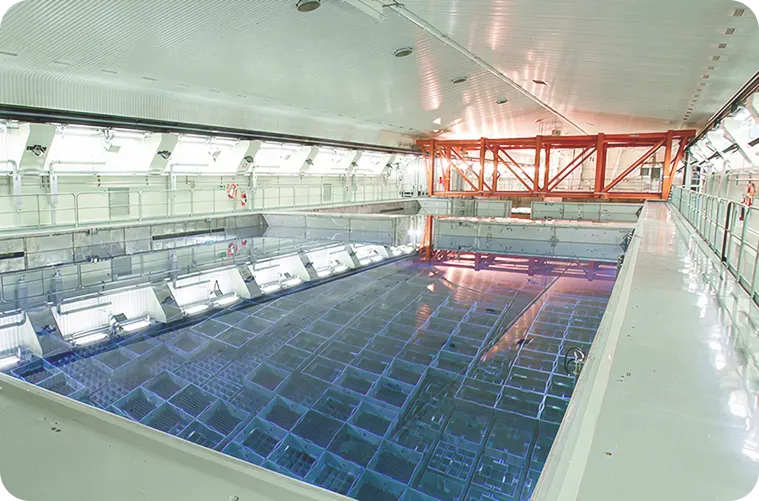
Spent fuel storage pools near reactors, as well as those at centralized facilities such as CLAB in Sweden, are 7-12 meters deep to allow several meters of water above the spent fuel. The numerous racks are made of metal with neutron absorbers incorporated. The circulating water both protects against radiation and cools the fuel. These pools are robust structures made of thick reinforced concrete with steel cladding. Reactor storage pools are often designed to store all the spent fuel produced during the planned operating life of the reactor.
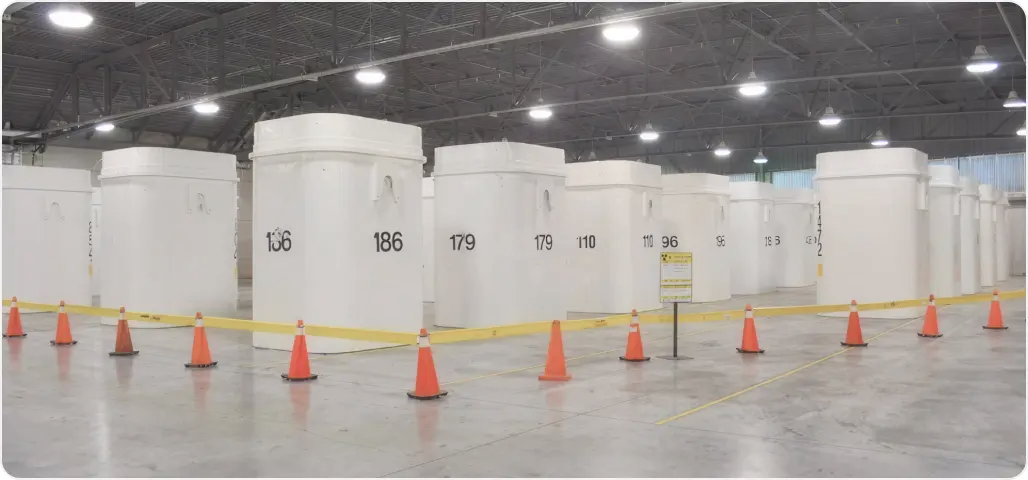
Spent fuel that is not reprocessed to extract the useful radioactive materials contained in it may be treated by the respective country's regulator as highly radioactive waste, subject to long-term storage in special underground repositories. However, this solution is currently only effectively implemented by Finland and Sweden, with the Swedish facility yet to be built. Both repositories are designed so that it is possible to subsequently extract Spent fuel from them for reprocessing or use as fuel in fast neutron reactors. Spent fuel for fast neutron reactors is an extremely valuable energy resource. For comparison, one kilogram of fresh fuel for current light water reactors contains 500 GJ/kg, while Spent fuel in a fast neutron reactor contains 28,000 GJ/kg, with the possibility of producing additional nuclear fuel (if the reactor is of the "breeder" type). From this point of view, the spent fuel stored at the Kozloduy NPP is one of the most valuable resources possessed by the Bulgarian state.
Treatment and value of spent nuclear fuel
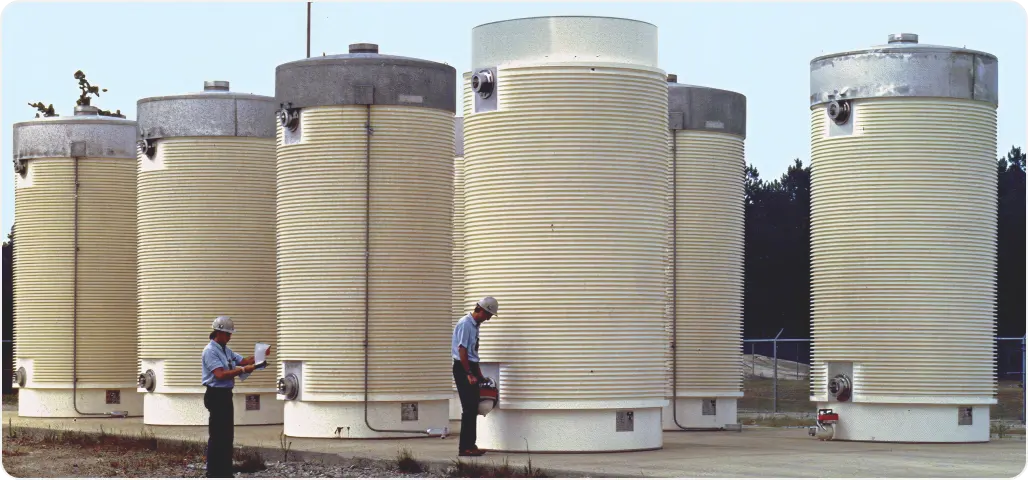
Claims are being spread in the public domain that the management of spent fuel, as well as the long-term storage of highly radioactive waste, are extremely expensive activities, and that the spent fuel and waste themselves are a huge danger to all people. In fact, the design of the dry storage containers for spent fuel allows, as can be seen in the photo above, people to safely sit and work next to them, without any danger to their health.
The steel and concrete in them completely shield the radiation, and the subsequent vitrification (glazing) of the highly radioactive waste left after the use of SNF in one way or another reliably guarantees that the radioactive substances will not spread into the environment. To get an idea of the cost of managing SNF and highly radioactive waste, it can be pointed out that the cost of the dry storage facility for SNF built at Kozloduy NPP for SNF from the closed small reactors is 70.5 million euros, which is significantly less than the cost of the electricity produced by these small reactors.
In the US, 0.1 cents/kWh of electricity produced and sold is set aside, in France, which reprocesses SNF, 0.14 eurocents/kWh are set aside. The construction of the long-term storage facility in Finland costs 3.5 billion euros, which is reflected as 0.3 eurocents/kWh of the electricity price over the 50-year operation of the country's currently operating nuclear reactors.
Spent fuel storage pools near reactors, as well as those at centralized facilities such as CLAB in Sweden, are 7-12 meters deep to allow several meters of water above the spent fuel. The numerous racks are made of metal with neutron absorbers incorporated. The circulating water both protects against radiation and cools the fuel. These pools are robust structures made of thick reinforced concrete with steel cladding. Reactor storage pools are often designed to store all the spent fuel produced during the planned operating life of the reactor.
Environmental impact assessment
In accordance with the requirements of Art. 81 of the Environmental Protection Act, the project company has taken action to carry out an environmental impact assessment (EIA) procedure. For the EIA of the construction of a new nuclear power plant at the Kozloduy NPP site, Kozloduy NPP – New Builds Plants EAD hired the international consortium Dikon AD – Axion Engineering, selected among seven candidates as a result of a competitive procedure.
The activities carried out under the above-mentioned Contract are related to the preparation of the "Terms of Reference for the Scope and Content of the EIA Report", carrying out an analysis and assessment, the results of which will be used to develop the EIA Report itself. Based on the legal requirements, independent analyses and studies have been carried out and consultations have been held with the interested institutions and the affected public, including in a transboundary context. Five meetings for public discussion of the EIA Report have been held in the Republic of Bulgaria and three in the Republic of Romania, opinions have been prepared in response to the comments of the affected public, and written consultations have been held with the competent authorities in the Federal Republic of Austria.
The results of the independent analyses and the assessment performed for all phases of the development of the investment project - construction, operation and decommissioning of the nuclear power plant, boil down to the following conclusions:
- No non-radiative impact on environmental components and factors is expected.
- No radiation impacts are expected on waters, lands and soils, geological environment, subsoil, land use, mineral diversity, biological diversity, ecology and cultural resources; areas inhabited by protected, important and sensitive species of flora and fauna; scenic areas; areas and sites of historical and cultural significance, sites protected by international or national law, as well as on human health.
- No negative impact is expected from the radioactive waste, provided that the decommissioning plans for the nuclear facility and all applicable Bulgarian and international legal requirements and practices are complied with.
- The contribution of the new facility to the radiation background in the vicinity of the town of Kozloduy from external radiation exposure is negligibly small even in cumulation with the existing nuclear facilities on the Kozloduy NPP site. The cumulative impact in terms of radiation on the environment is assessed as insignificant and no cumulative impact in terms of non-radiation is expected.
- No transboundary impact is expected. On the territories of neighboring countries.
On 27.01.2015. The Minister of Environment and Water approved the EIA report for the construction of a new nuclear power plant at the Kozloduy NPP site, considering two alternatives for technical solutions for nuclear facilities: alternative A 1 and alternative A 2 (a completely new reactor design).
The decision of the Minister of Environment and Water has been appealed by representatives of non-governmental organizations and an administrative case has been filed before the Supreme Administrative Court (SAC). This is a common practice for a small group of highly motivated and dubious „ecological experts“ to suspend or delay the implementation of serious state projects.
